If Russia winning its first Paralympic gold medal since 2014 at the Milano Cortina Winter Olympics on Monday wasn’t shocking enough given the country’s invasion of Ukraine recently entered its fifth year, Russia’s attempted return to the international artistic fold at this year’s Venice Biennale of Contemporary Art does seem to be generating widespread outrage.

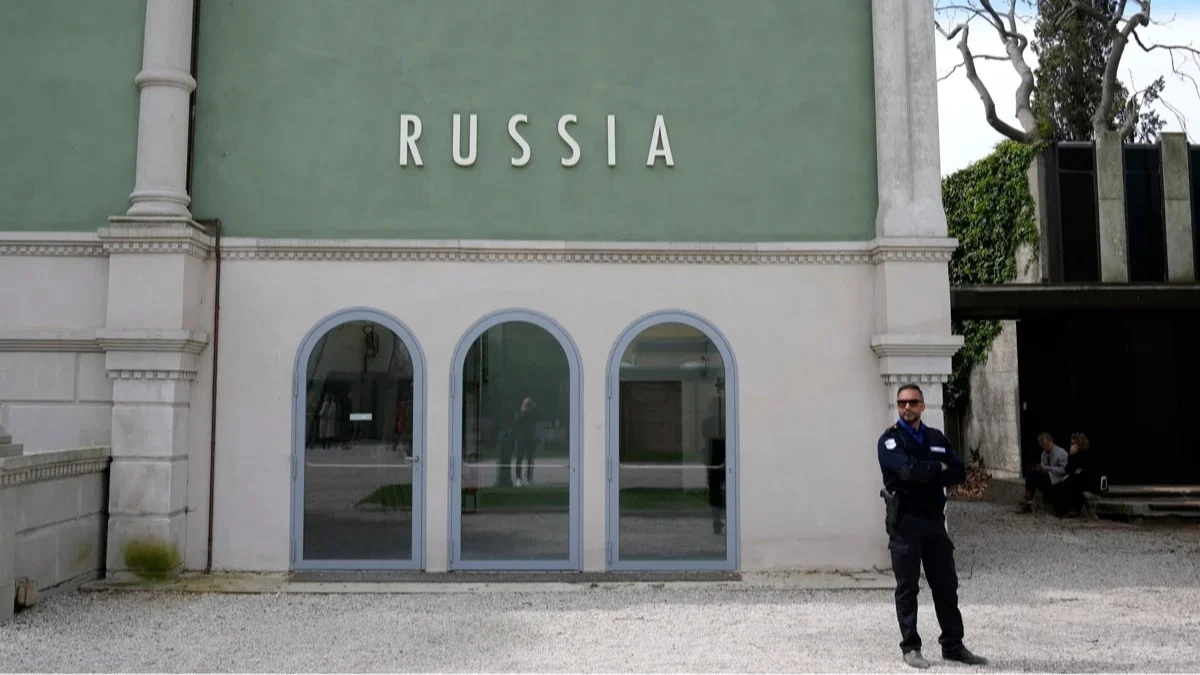
Russia’s return to its storied pavilion at the Giardini will be the country's first appearance at the prestigious artworld event since the start of its full-scale invasion of Ukraine in 2022, when the Russian artists awarded the commission withdrew from the project in protest, leaving the pavilion to stand empty for the duration of the seven-month event.

The Russian art collective Pussy Riot, several members of which have first-hand knowledge of just how little tolerance the Putin regime has for self-expression, was among the first to express its outrage at the scale of the international community’s collective amnesia about the Kremlin’s crimes and argued strongly against allowing its return to the art world’s most prestigious event.

Original sin

The irony is that Russia was never actually banned from participating in the biennale — the last-minute withdrawal of Russian artists Kirill Savchenkov and Alexandra Sukhareva, as well as the Russian pavilion’s Lithuanian curator Raimundas Malašauskas, in 2022 left Moscow no option but to skip the event, with the three calling the war “politically and emotionally unbearable,” and insisting that there was “no place for art in conflict”.

No doubt sensing that the international community wasn’t ready for a Russian return to Venice ahead of the next biennale in 2024, Russia simply loaned its coveted pavilion in the main walkway of the Giardini to its friends in Bolivia, a rather brilliant way to shield itself from any further criticism while also burnishing its credentials as a force for good in the Global South.

Since then, that zero-sum game appears to have been transformed into one that Moscow believes it has a chance to profit from, and so has re-entered the fray for the 61st biennale, which is due to open on 9 May, a date already considered auspicious in Putinist Russia, being a national holiday of an increasingly jingoistic nature on which the Soviet Union’s (single-handed) triumph over Nazi Germany is celebrated.

“I would like to note that Russia never left the Venice Biennale,” Putin’s Special Representative for International Cultural Cooperation Mikhail Shvydkoy, told ARTnews last week. “Therefore, since we have not gone anywhere, we are not ‘returning.’ We are simply seeking new forms of creative activity in the current circumstances.”

Citing the fact that the exhibit being mounted at this year’s Russian pavilion will involve more than 50 artists from all over the world, Shvydkoy said that this was “further proof that Russian culture is not isolated, and that attempts to ‘cancel’ it — undertaken for the past four years by Western political elites — have not succeeded.”

“That is precisely why we decided to create a project in which a multilingual polyphony of cultures will be heard — cultures that do not consider themselves peripheral in relation to the West,” he added.

Pie in the sky

Titled “The Tree is Rooted in the Sky,” the exhibit will centre on the idea that “politics exists within temporary dimensions, whereas cultures communicate in eternity,” Shvydkoy explained. “In our new project, eternity prevails over momentary concerns, culture over politics… unfortunately, not everyone is capable of understanding this.”

On the Russian pavilion's Instagram page, the project is described as a “wide-ranging cultural initiative”. The organisers plan to make the space one in which “a true musical festival will come to life, featuring musicians from various regions of Russia and from countries such as Argentina, Brazil, Mali, and Mexico.”

The event aims to highlight “the creative potential of peripheral areas and practices, showcasing traditions, musical languages, and experimental approaches that emerge far from major cultural centers”, but precisely because of this, it will also “preserve an authentic and innovative expressive power”.

”No one can deprive Russia of the right to artistic self-expression,” Shvydkoy said defiantly.
“Through the meeting of different cultures, the project aims to create a space for dialogue and exchange, where local roots can intertwine with global visions, generating new artistic perspectives and strengthening a sense of international community,” the post continues.

“Various sanctions may be devised, and official Western institutions may be prohibited from working with us, but no one can deprive Russia of the right to artistic self-expression,” Shvydkoy said defiantly, though he added that the Biennale itself was “ready to seek a compromise [to ensure the pavilion remains open], naturally without wishing to jeopardise the work of the entire Venice Biennale.”

The organisers of the Biennale themselves have stressed that they do not decide which countries will participate in the exhibition.

Curated by Rostec

It could perhaps be argued that the Russian pavilion at Venice wasn’t inherently political in nature, were it not for the fact that Anastasia Karneyeva, who was appointed its commissioner in 2021 for an eight-year term, is the daughter of Nikolay Volobuev, who has been the deputy director general of Rostec, a state-owned defence conglomerate, for almost two decades.

Prior to that appointment, Volobuev served in FSB and in its Soviet-era predecessor the KGB, as well as the deputy head of Russia’s customs authority. He is also on Kalashnikov’s board of directors, making the appointment of Karneyeva a political one — there are simply no coincidences like this in Putinist Russia.

Karneyeva is married to Moscow businessman Dmitry Karneyev, who, according to independent Russian media outlet Proekt, from 2010–2017 was chairman of the board of the commercial bank Khovansky, “which since the 1990s has been used for financial transactions by the Izmailovo organised crime group”.

Having studied at University College London, Karneyeva went on to work for Christie's auction house in Russia before becoming a self-styled “collector and patron of contemporary artists” alongside Yekaterina Vinokurova, the daughter of Russian Foreign Minister Sergey Lavrov, with whom she owns Smart Art, the company that was ultimately awarded the contract to manage the Russian pavilion in the Giardini.

Running riot

Upon learning of Russia’s planned comeback at this year’s Venice Biennale, Pussy Riot immediately announced that they would be leading the push back, denouncing the move as “a political decision by Italy” and publicly accusing the event’s organisers of lying when they said that Russia’s participation was beyond their control.

“The Biennale consists of the main international exhibition and national pavilions. One of them is the Russian pavilion. However, although the building belongs to Russia, it is located in the Giardini, which are the property of the Italian state and the city of Venice, and it functions only through agreements with the Biennale. The president of the Biennale is appointed by the Italian government,” the group’s statement said.

“The Russian pavilion is not an embassy: it is not sovereign territory and does not have diplomatic status. This means that the Italian government, the authorities of Venice, and the Biennale itself can say ‘no’ to Russia if they choose to.”

Pussy Riot also described Russia’s participation in the Biennale as “a serious blow to Europe’s security”, and noted that since the start of its full-scale invasion of Ukraine, cultural “soft power” had become part of Russia’s military doctrine and an instrument of hybrid warfare.

“It is the cultural expansion of imperial Russia into the heart of Europe. Pussy Riot is coming to Biennale with an intervention. We want to express unconditional support for Ukraine, for the victims of Russian war crimes, for Russian political prisoners, and for Ukrainian prisoners of war.”

Pussy Riot ended its statement by lamenting the fact that Russia’s “best” citizens were nowadays either “sitting in prison for anti-war gestures or have been killed — while Europe opens its doors to Putin's officials and propagandists”.

Поделиться
Подробнее по теме
Изображение материала
‘I want Ukraine to win, and I’ll do everything to make that happen’
Pussy Riot’s Nadezhda Tolokonnikova on donating to the Ukrainian Army and art as a weapon against dictatorship
Темы
Больше сюжетов
Льготы до гроба

Льготы до гроба

Объем помощи участникам «СВО» в девять раз превышает господдержку многодетных семей: исследование «Новой-Европа»
«Заводы стоят»

«Заводы стоят»

В 2025 году российские компании стали в 1,4 раза чаще сокращать сотрудников или переводить их на неполный рабочий день. Исследование «Новой-Европа»
1280 раз сообщалось о коммунальных авариях в январе — в два раза больше, чем год назад

1280 раз сообщалось о коммунальных авариях в январе — в два раза больше, чем год назад

Почему ЧП так много и как выжить в мороз?
Дом, в который пришла война

Дом, в который пришла война

Спецпроект «Новой-Европа» о преступности ветеранов «СВО»
Краткая история ненависти

Краткая история ненависти

«Новая-Европа» изучила пять миллионов публикаций в провластных СМИ и составила хронологию травли оппозиции, мигрантов и приверженцев «нетрадиционных ценностей»

О чем спорили боты

О чем спорили боты

Топ-10 новостей 2025 года, на которые активнее всего реагировали прокремлевские аккаунты в соцсетях
Война на карте России

Война на карте России

2025 год стал рекордным по количеству атак беспилотников по российским регионам. В среднем падает или попадает в цель 11 дронов в день
Российские регионы один за другим вводят запрет на «склонение женщин к абортам»

Российские регионы один за другим вводят запрет на «склонение женщин к абортам»

Где уже действует законопроект, а где его только обсуждают. Карта
Больше четырех тысяч аварий произошли на российских энергообъектах в 2025 году

Больше четырех тысяч аварий произошли на российских энергообъектах в 2025 году

Причина каждого десятого отключения света – атака ВСУ, остальные – износ инфраструктуры. На ремонт денег нет