Dead end
In the past 10 months, Russia managed to only capture about 4% of Donbas. Troops are basically treading water while losses are mounting. Novaya Gazeta Europe dissects Russia’s war effort in Ukraine
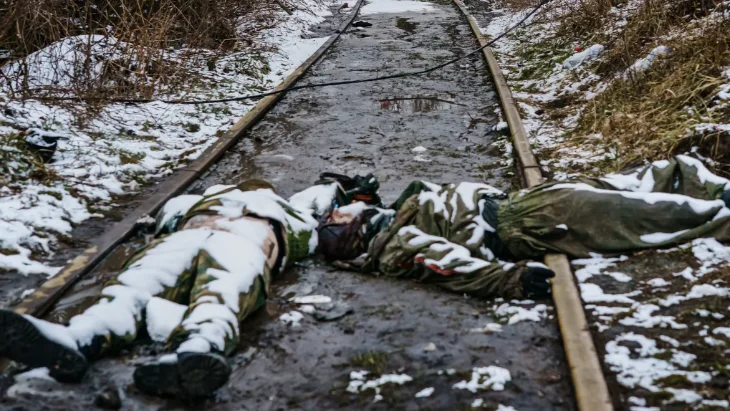
Having started the war with an attempt to “capture Kyiv in three days”, Russia has officially bogged down in fighting in 2023. The Battle for Donbas has been going on for nine months, and the Russian army spent six of them standing in one place. Russia only managed to seize a little over 2,000 square kilometres of territories in bloody clashes, or just 4% of Ukraine’s Donetsk and Luhansk regions. The last major city that Russian forces occupied was Lysychansk in early July. Novaya-Europe’s data department takes a closer look at the Kremlin’s blitzkrieg that turned into a long war of attrition which it most likely cannot win.
Ukrainians woke up on 24 February 2022 to nationwide missile strikes.
Russian forces launched five offensive operations. They were advancing in the north on Kyiv and Kharkiv, in the south on Kherson and Mariupol and in the east and north on the Luhansk region.
By 28 March, Russia had occupied over 25% of Ukraine’s territories: 155,000 sq.km. However, the main objective was not reached: efforts to encircle and seize Kyiv failed. Ukrainian defence proved to be effective. The Russian army was sustaining great losses and was troubled by logistical issues.
Russian Defence Minister Sergey Shoigu on 29 March announced that the “first stage” of the “special military operation” was completed. On 4 April, Russia withdrew its troops from the Kyiv, Chernihiv, and Sumy regions.
In total, Russia was pushed out of 15,000 square kilometres of land since 18 April. This is equal to losing Russia’s Kaliningrad region.
TIMELINE OF RUSSIA’S CHANGING WAR GOALS
On 24 February 2022, Russian President Vladimir Putin announced the beginning of a “special military operation” in Ukraine. He set out a few major goals:
- “to protect people who have been subjected to abuse and genocide by the Kyiv regime for eight years”;
- to demilitarise and denazify Ukraine;
- “to bring justice to those who committed many atrocities against civilians, including Russian citizens”.
According to military expert David Sharp, the “denazification” in Putin’s mind meant seizing power in Ukraine, while the “demilitarisation” signified elimination of Ukraine’s armed forces.
By April-May, the Russian army’s goals were less ambitious:
- to control captured territories;
- to fully occupy the Donetsk and Luhansk regions — Russian Defence Ministry;
- to establish full control over southern Ukraine — Deputy Commander of the Central Military District Major General Rustam Minnekaev;
- to ensure Ukraine’s non-nuclear and neutral status — Shoigu;
- to maintain security for east Ukraine residents — Russian Foreign Minister Sergey Lavrov.
By the end of 2022, Russia had abandoned plans to form a land bridge to Transnistria, Moscow-backed breakaway region of Moldova, and put pressure on Kyiv. The war goals in December were:
- to help Donbas — Putin;
- to capture all territories of the occupied regions — Kremlin spokesman Dmitry Peskov;
- to defend “Russia’s four new regions” — Lavrov;
- to crush Ukraine’s military potential — Shoigu.
The Russian army barely moved a kilometre in the past six months of the Battle for Donbas that started nine months ago. Soledar with its population of 10,000 people is the biggest settlement seized by Russia in Donbas since July.