Varvara Voronchikhina wins Russia’s first Paralympic gold since 2014
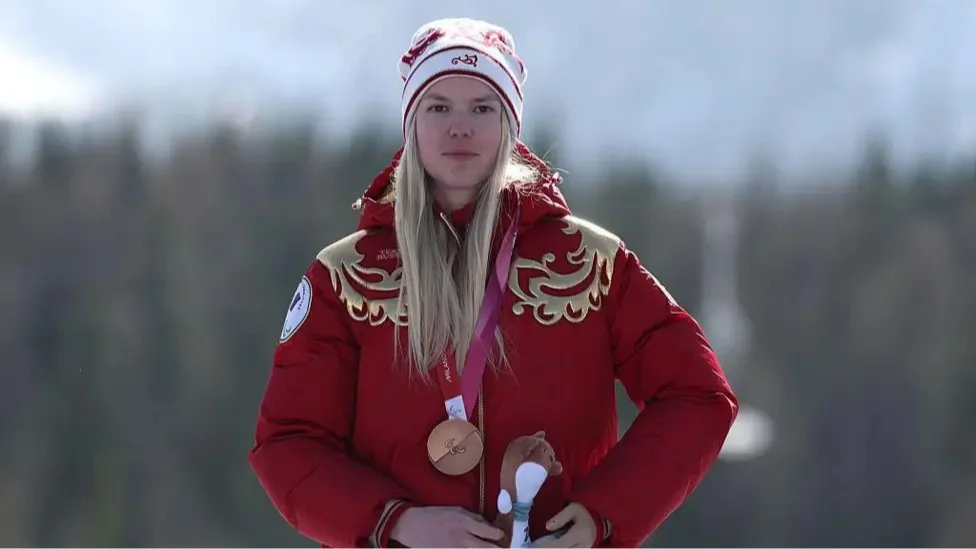
Russian para-alpine skier Varvara Voronchikhina won Russia’s first gold of the Paralympic Winter Games on Monday, meaning that the Russian national anthem will be played at a Paralympics medal ceremony for the first time since the Sochi Winter Olympics 2014.
Two days after taking Russia’s first bronze medal in the standing downhill, 23-year-old Voronchikhina won the women’s super-G (standing) event, which took place at the Tofane Alpine Skiing Centre in Cortina on Monday morning.
Speaking to Russian sports broadcaster Match TV after her victory, Voronchikhina thanked all the fans who had supported her and said: “We are a big country, and I cannot believe that our anthem will be heard today — I have goosebumps!”
This is the first time that Russia has been allowed to participate in the Paralympics under its own flag and anthem since 2014. The decision of the International Paralympic Committee (IPC) to let six Russian and four Belarusian athletes compete in the games has drawn fierce criticism, however, leading to several European countries joining Ukraine in boycotting the opening ceremony over the presence of the Russian flag on Saturday.
Russia was originally banned from the Paralympics in 2016, due to the participation of both Russian Olympic and Paralympic athletes in a state-sponsored doping programme. In 2018, Russian athletes returned to the Paralympics under the three-crescent “Agitos” flag, the Paralympic version of the Olympic rings, while in 2020 they competed under the flag of the Russian Paralympic Committee.
Russia was once again banned entirely from the Paralympics in 2022, having launched its invasion of Ukraine just two weeks before the games’ opening ceremony in Beijing, in violation of the traditional “Olympic Truce”.
Justifying their readmission, the IPC argued that Russia and Belarus had been suspended for using the Paralympics as part of their military propaganda, which it said no longer appeared to be the case in 2026.
At a congress of the IPC in 2025, 91 countries voted in favour of readmitting the Russian and Belarusian Paralympic Committees as full members. The countries later won an appeal at the Court of Arbitration for Sport against the International Ski and Snowboard Federation, which had maintained its opposition to Russians and Belarusians competing at Paralympic snow events. As a result, 10 para athletes from the two countries were invited to participate with their full national regalia, including Voronchikhina.
IPC President Andrew Parsons has publicly defended Russia’s participation at the Milano-Cortina Paralympics, saying that the IPC’s democratic processes must be respected. In an interview with the BBC on Friday, he also indicated he was happy to let Russian veterans from the war in Ukraine compete at the Paralympics, saying: “We are against any war, any conflict, but what we offer is an opportunity for those who are injured in war to be reintegrated into society through sport.”
The situation for Russians at the Paralympics differs markedly from that at the Winter Olympics held last month, where a limited number of Russian athletes competed under a neutral flag and anthem, and did not participate in the opening or closing ceremonies.